

Physician practices routinely evaluate ancillary services for their potential to improve practice profitability.
Traditional ancillaries tend to add two things at once: a revenue opportunity and another operation to run. The practice typically has to manage the operating factors that determine whether the service generates a return, including patient volume, equipment, staffing, training, and day-to-day execution.
Laboratory testing has often escaped that ancillary evaluation for the opposite reason. The practice already generates clinical activity, but when testing is outsourced, the reference laboratory owns the operating and financial responsibilities.
A fully managed laboratory model changes that. The practice can evaluate eligible laboratory activity for its potential contribution to margin without having to independently build, staff, and manage the specialized infrastructure required to support it.
What actually makes an ancillary service contribute margin?
An ancillary service can generate substantial revenue and still make a relatively small contribution to practice profitability.
Consider an OB/GYN group expanding its ultrasound services. Leadership may identify sufficient patient demand and favorable reimbursement, but the financial case must also account for equipment, sonographer staffing, dedicated space, maintenance, billing and ongoing management.
These are familiar business decisions, and practice leadership understands that adding a billable service does not automatically produce additional profit.
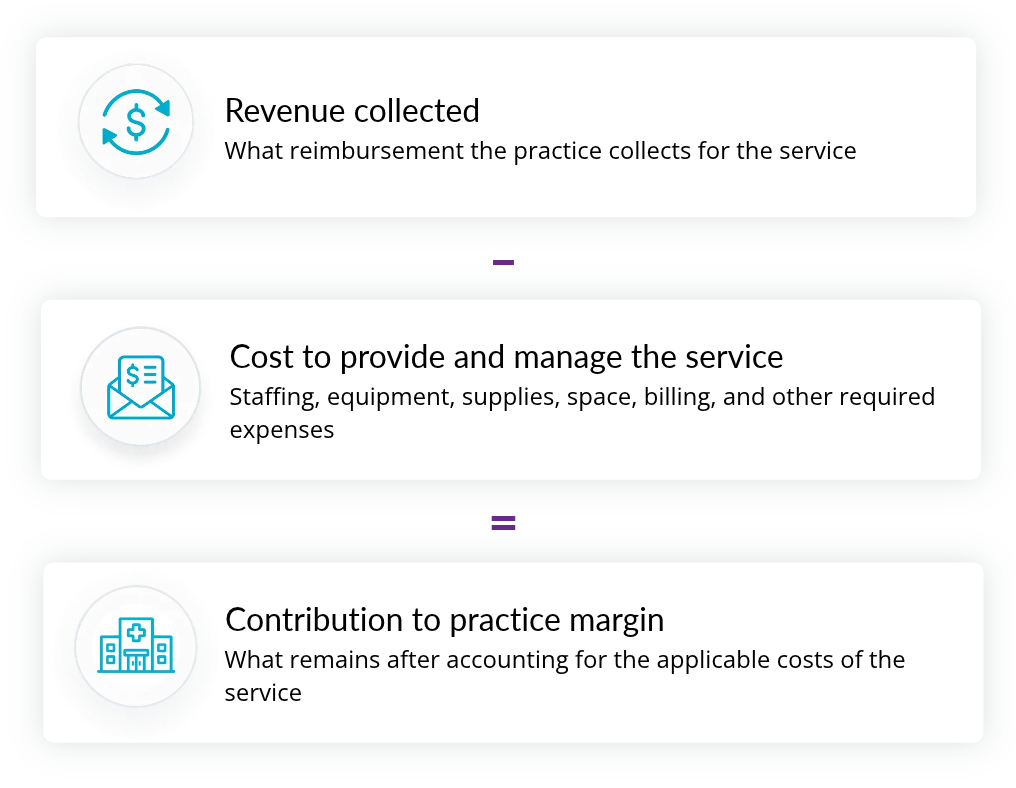
A financially attractive ancillary therefore needs sufficient demand and an operating structure that allows the practice to retain a meaningful contribution after accounting for its costs. Laboratory testing belongs in that same evaluation of ancillary services.
Apply the margin calculation to laboratory testing
Physician practices that already order laboratory tests as part of routine and specialty care can begin with a practical financial question: how that existing clinical and reimbursement activity is structured.
When testing is outsourced, the reference laboratory generally performs the tests, handles billing and receives the associated reimbursement. When testing is performed in-house, the practice becomes responsible for both testing and revenue cycle management.
Applying the same ancillary-service calculation brings three considerations into focus for laboratory testing.
Existing testing volume
The first step is understanding how much laboratory activity the practice already generates. Leadership can examine the tests physicians order, the volume sent to reference laboratories and any testing already performed in-house.
Existing utilization provides a starting point for the financial assessment. The next step is determining which testing activity may qualify for a different reimbursement and operating model.
Available reimbursement through client-billing or in-house testing
For certain eligible outsourced laboratory testing, a client-billing arrangement may allow the physician practice to serve as the billing entity while a participating reference laboratory continues performing the tests.
Certain physician groups may also evaluate the potential to perform appropriate testing through an in-house laboratory.
This is where the financial assessment becomes specialized. Client billing eligibility varies by test, payer, contract and location, while an in-house lab has to be evaluated like any other business line: against applicable reimbursement, payer requirements, collection realities and the full cost of operating the testing itself.
The cost of supporting the services
Both client-billing and in-house testing require laboratory-specific knowledge, processes, and capabilities.
Client billing requires:
- Staff to properly submit laboratory claims, follow up on unpaid or denied claims, and manage collections
- Training on laboratory-specific billing requirements
- Billing software built for laboratory billing
- Patient statement and payment-processing systems
- Payer enrollment, contract review, and eligibility work
- Compliance oversight
- Ongoing management of the billing workflow
- And more
In-house lab testing requires:
- Laboratory equipment and maintenance
- Laboratory staff
- Staff recruiting and training
- Testing supplies and consumables
- Laboratory information/reporting systems
- Billing staff and reimbursement systems
- Quality and compliance processes
- Ongoing operational management
- And more
Applying the familiar margin calculation to laboratory testing is harder than it looks. The variables are more specialized, the reimbursement rules are less visible to practice leadership, and the operating requirements are easy to underestimate.
Before a practice tries to model these opportunities on its own, there is another way to structure the calculation.
How fully managed laboratory services change the financial equation
A fully managed laboratory model changes both what the practice has to operate and how it accounts for the cost of pursuing the opportunity.
Rather than requiring the practice to hire, develop and oversee every specialized function necessary for client billing or in-house testing, Phytest builds and manages the applicable laboratory infrastructure as part of an ongoing partnership.
For eligible outsourced testing, Phytest evaluates where client billing applies and manages the laboratory-specific billing processes from ordering through collections with our lab financial management service.
For in-house testing through a physician-owned lab, Phytest builds, staffs and manages the practice’s laboratory and its revenue cycle management through our lab management services.
In both cases, Phytest works with medical practices as an extension of their existing team. Phytest remains accountable for the infrastructure it manages, while physicians, staff, and leadership continue to perform the practice-side responsibilities in routine lab testing.
The cost side of the margin calculation changes, too. Phytest’s performance-based compensation is tied to the collections generated through the managed client-billing or in-house laboratory service. That structure puts both organizations behind the same financial goal: the practice and Phytest benefits when the laboratory services perform.
That changes the ancillary-margin calculation. Instead of asking whether the practice can absorb the people, systems, and management required to operate another service line, leadership can evaluate whether existing lab activity supports the managed cost of the laboratory model.
Could laboratory testing contribute to your ancillary margin?
The same financial calculations used to evaluate ancillary services can be applied to laboratory testing. However, laboratory operations and reimbursement have their own language, and most practices have never been taught how to speak it fluently.
If leadership is asking any of the following questions, it may be worth having Phytest evaluate the opportunity:
- Are we already generating enough laboratory activity to justify a closer financial look?
- Could some of the testing we currently outsource qualify for a different reimbursement model?
- Could certain testing make sense to perform in-house?
- Are there payer, contract or reimbursement details we are likely to miss by evaluating this with general assumptions?
Phytest evaluates the testing activity, reimbursement environment, operating requirements and applicable laboratory model together to determine whether there is a viable opportunity.
For practices that qualify, laboratory testing can move from something that happens in the background to something leadership evaluates like any other ancillary service. The difference is that the practice does not have to become an expert in another ancillary world to find out whether the margin opportunity is there.